When you tow a caravan, the mirror you rely on most stops working. All it shows you is the front of the van behind you, and the combination you are driving has just got a lot longer.
That is the problem a rear-view camera system solves. The monitor clips onto your existing rear-view mirror, the camera mounts on the back of the caravan, and you get your rear view back in the place you already look for it.
Reversing is part of it, but honestly it is the smaller part. The bigger value is the continuous rear view while you are driving, the recorded footage if something goes wrong, and a third use that most owners never think of: moving the same camera onto the awning as a caravan security camera once you are parked up.
At Falcon we have been helping caravan and motorhome owners since 1991. Honest advice is part of what we do.
Let’s get into it.
Hitch up a caravan and your interior rear-view mirror becomes close to useless. The view through the back window is the front of the caravan and nothing else.
At the same moment, your vehicle has become considerably longer. You need good rear visibility more than you did five minutes ago, and you have just lost most of it.
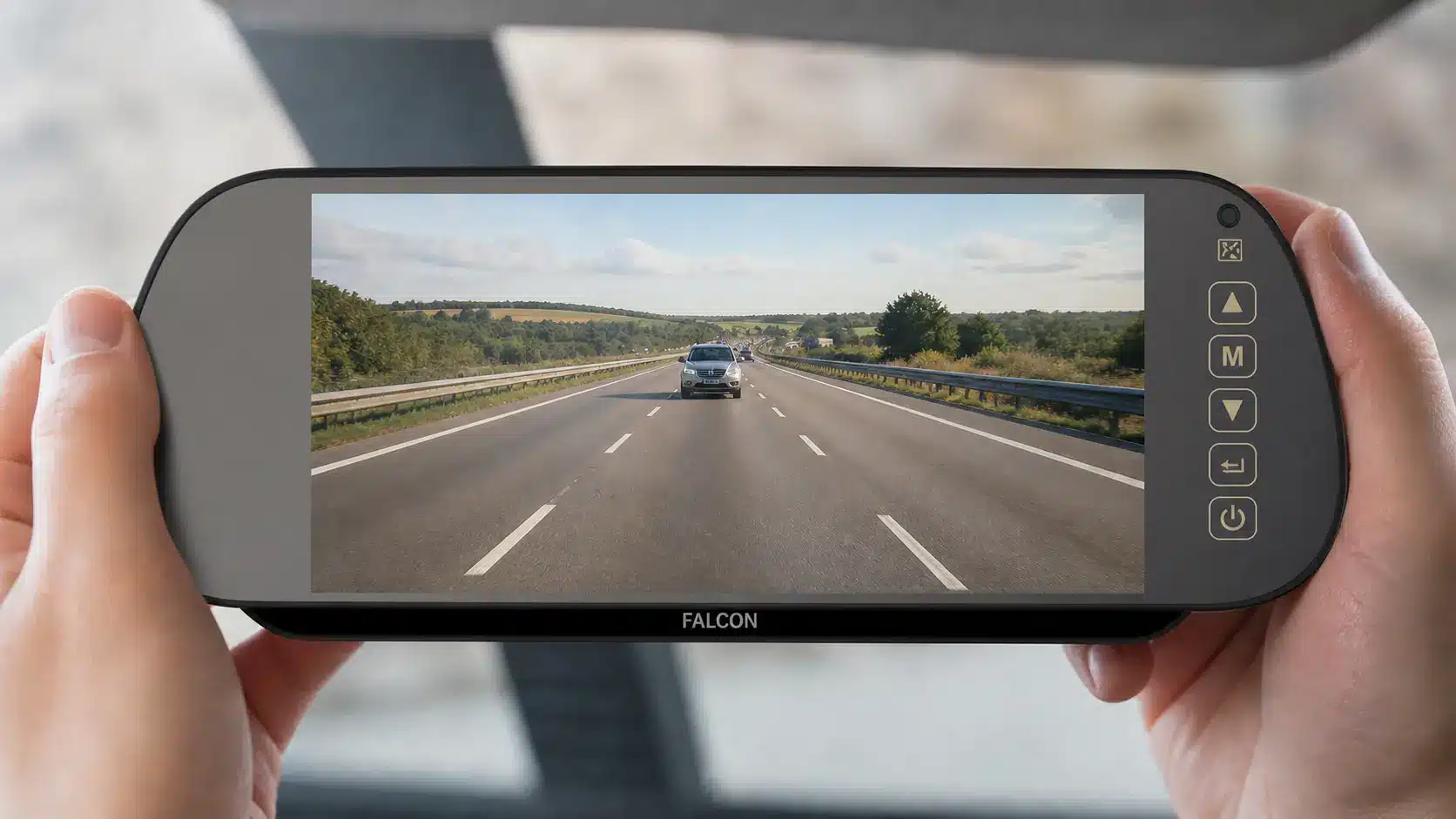
The Falcon system puts it back. The 7-inch monitor clips over the mirror you already have, so the picture appears where your eyes go naturally. The magnetic camera sits on a fixing plate on the rear of the caravan, sending a live view of the road behind you. No drilling, and nothing to relearn.
Wing mirrors show you down the sides of the van. They do not show you what is directly behind it, and that is the gap.
Overtaking a lorry on the motorway is where this earns its keep.
Your wing mirrors give you the side of the lorry. What they do not tell you reliably is whether the back of your caravan has actually cleared it. Pull in early with a long combination and you know about it.
With a live view from the rear of the caravan, you glance at the mirror monitor, see the lorry properly behind you, and move back into the lane knowing you are clear. That one moment, repeated on every trip, is the strongest argument for the system.
The reversing benefit is real, it is just not the headline.
A clear, high-definition view of everything behind the caravan turns backing onto a tight pitch from a two-person job into something you do calmly on your own. Manoeuvring in a busy site, lining up on a hitch, edging into a storage space: all easier when you can see.
Think of it as a useful bonus on top of the driving benefit rather than the reason to buy.
Inside the system is a digital video recorder, the same basic technology behind dashcams and CCTV, built into the camera itself.
The Falcon HD Magnetic Wireless Camera System records to an SD card and comes with a 32GB card included, with support for cards up to 128GB. Footage plays back on the monitor, or later on a PC or Mac.
Recordings are time and date stamped, which is the detail that matters if you ever need them. Whether an incident happens while you are driving, while you are manoeuvring, or while the vehicle is sitting still, you have a factual record of what occurred rather than two conflicting accounts. That can make a genuine difference to an insurance claim or a dispute.
A 32GB card holds roughly a day of recording at typical quality settings. Systems of this type overwrite the oldest footage first once the card fills, so recording carries on without you having to manage it.
When the light drops, built-in infrared LEDs keep it recording a clear black-and-white picture. Dark campsites, unlit car parks, early departures before sunrise.
This is the one most owners miss, and it costs very little to set up.
The camera is held on by a magnet. Add a second metal mounting plate on the side of the caravan, positioned to look over the awning, and you have somewhere else to put it.
Once you are parked and set up, lift the camera off the rear plate and move it to the awning plate. It takes seconds. The same camera you towed with now watches the awning overnight.
That matters because of what people leave out there. Barbecues, chairs, tables, windbreaks, bikes, cooking gear. Most of it stays out all night because carrying it inside every evening defeats the point of the awning.
You already own the camera. A second plate turns it into a second job.
The drive-off on a pitch. Someone in the next pitch reverses into your motorhome while manoeuvring, causes damage, and drives off without leaving details. Without footage it is your word against theirs. With a recording you have something to show your insurer, and that makes for a far simpler claim.
Deterrence. A visible camera is a signal. Anyone thinking about interfering with your caravan or your awning can see they are being recorded. Opportunist theft is, by definition, a low-effort crime, and a camera that is clearly present often sends the opportunity elsewhere.
Evidence after tampering. If someone tries to get into your caravan or take something from under the awning, footage can capture the attempt. That is not a guarantee of recovery, but it is exactly the sort of evidence that supports a police report and an insurance claim.
Settling disputes. Disagreements about pitch positioning, damage or access are rare, but they happen. Footage of what actually occurred takes the ambiguity out of the conversation.
One honest limit: this is one camera. It covers wherever you have pointed it, the rear while towing or the awning while parked, and not both at once. It is not all-round coverage, and knowing that helps you use it properly as part of a wider setup.
Both benefit, you just use it differently.
A motorhome is driven, parked, and often left while you go exploring. A camera that keeps recording while the vehicle is unattended is watching the van while you are not there. Motorhome owners may also want the monitor hardwired to the ignition circuit, so it powers up with the engine rather than needing switching on each time.
A caravan is towed and then left, often for a full season on a pitch or in a storage compound between trips. Here the magnetic camera’s removability is a genuine advantage: it lifts off in seconds for winter storage, away from frost and damp, and clips straight back on before your next trip. It is also what makes the awning trick possible.
A dashcam records forward-facing footage while you drive, capturing the road ahead from the driver’s point of view.
A rear-view camera with built-in DVR recording is the rear-facing equivalent, and it does a job the dashcam cannot: it shows you what is behind a vehicle you can no longer see past.
A full CCTV system usually means several cameras covering different angles, a central recorder and often remote monitoring. A home system covering a property from four or six angles is a different category of product.
The Falcon system sits in the middle. It is a driving aid first, a recorder second and a single-camera security tool third, and it is not a replacement for a dedicated multi-camera CCTV installation. If you want to compare the camera systems themselves, our guide to choosing a rear camera goes through the options.
A camera is one layer.
The most secure caravan and motorhome setups combine several tools, each doing something the others cannot.
A camera gives you visibility and evidence. It shows you what is behind you while driving, records what happens, and deters opportunist interference when parked.
An alarm deters and alerts. A good caravan or motorhome alarm detects intrusion, sounds an audible warning and can notify you directly. It is an active deterrent, the kind that makes an intruder stop and leave.
A tracker helps you recover the vehicle. If the worst happens and your van is stolen, a GPS vehicle tracker gives recovery services what they need to locate it. It is the layer that matters when prevention has not worked.
Used together, the three cover different stages of an incident. None of them is a complete solution on its own.
Both of our HD camera systems include DVR recording as standard.
The magnetic system is the no-drill option. It mounts on a supplied metal plate, so there are no holes and no warranty worries, runs on a built-in 9,900mAh rechargeable lithium battery, and trickle charges from an integrated solar panel while you travel. It comes with the 32GB card and a 7-inch mirror monitor that clips over your existing mirror, and it is available in black or white. It is also the one you can move to a second plate for awning duty.
The Falcon HD Wireless Camera System is the alternative where a fixed installation suits the vehicle better.
Both monitors support up to four cameras, so you can add more views later. You can see the systems and their accessories side by side in the full wireless camera range.
A rear-view camera does far more than help you park. It gives you back the view towing takes away, records what happens while you drive, and doubles as a caravan security camera over the awning once you are pitched. If you want that, and the alarms or trackers to go alongside it, our team is happy to talk through the right setup for your vehicle: call us on 0800 622 474.
Both work as a caravan security camera. The difference is how they mount, and how much footage each one holds.
| HD Magnetic Wirelessno-drill | HD Wirelessfixed install | |
|---|---|---|
| Fitting | Magnetic, no drilling. Mounts on a supplied coated metal plate | Fixed installation |
| Power | Built-in 9,900mAh rechargeable lithium battery, solar trickle charging, USB recharge | 12V permanent feed from the leisure battery or similar |
| Camera | HD | Full HD 1920 x 1080 |
| Viewing angle | 125° | 110° |
| Wireless range | Up to 100 metres | Up to 50 metres |
| Night vision | Infrared LEDs | Infrared LEDs |
| DVR recording | Yes, to SD card | Yes, to SD card |
| SD card included | 32GB | 64GB |
| Maximum card size | 128GB | 512GB |
| Monitor | 7-inch clip-on mirror monitor | 7-inch AHD clip-on mirror monitor, detachable |
| Cameras supported | Up to 4 | Up to 4 |
| Also supplied | Metal mounting plate, USB lead and 12V adapter | Monitor hardwiring kit, full fitting kit, protective carry case |
| Best for | Avoiding holes in the vehicle, and portable or occasional use | A permanent setup, and the longest recording capacity |
Is this a reversing camera or a rear-view camera?
Both, but it is a rear-view driving camera first. The main benefit is continuous visibility behind a caravan while you are towing, when your interior mirror shows you nothing but the van. Reversing and manoeuvring are a useful bonus on top.
Can I move the camera to watch my awning?
Yes. The camera is magnetic, so with a second metal mounting plate fitted on the side of the caravan you can lift it off the rear plate when you arrive and reposition it to overlook the awning.
Does it record continuously?
The Falcon HD camera systems record to a built-in DVR, with recordings time and date stamped. Once the SD card is full, systems of this type overwrite the oldest footage first, so recording does not simply stop when the card runs out of space.
Do I need to buy an SD card separately?
No. The Falcon HD Magnetic Wireless Camera System includes a 32GB SD card, and it supports cards up to 128GB if you want more storage.
Can it record while the van is parked or overnight?
The magnetic camera runs from its own rechargeable battery rather than the vehicle’s supply, so it can keep working while the van is stationary. Infrared night vision keeps the picture usable after dark.
Is a camera a substitute for a caravan alarm?
No, and it is worth being clear about that. A camera gives you visibility and footage after the event. For proper protection it works alongside an alarm and a GPS tracker, each covering what the others cannot.